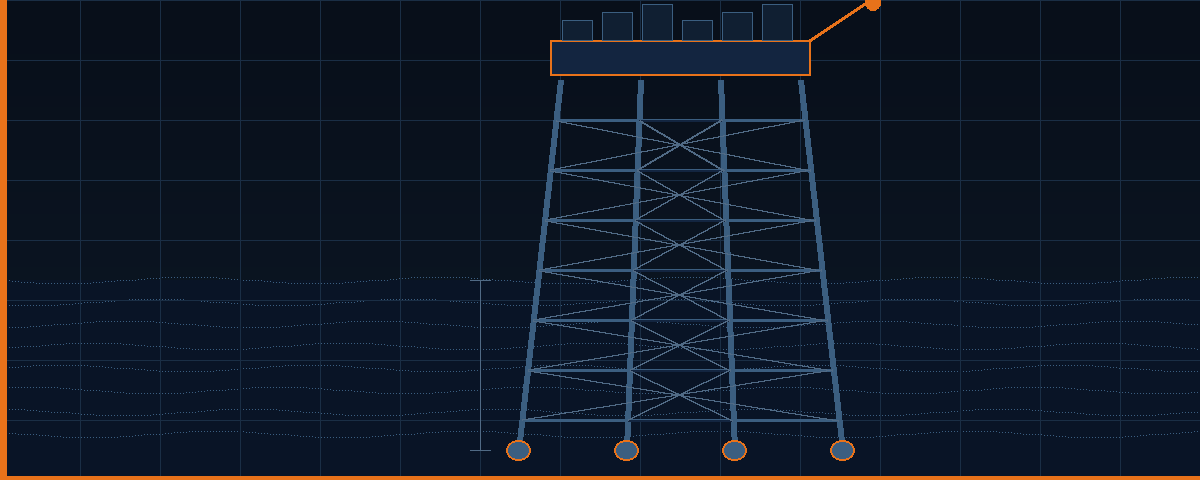
Offshore Structural Engineering — 15A Series
12 comprehensive lectures covering the full lifecycle of fixed offshore jacket platforms — from environmental loads through fabrication, installation, and structural connections. Updated to API RP 2A, ISO 19902, and DNVGL codes.
Course Lectures
Click any lecture to read the full content — no login required. Each lecture includes theory, worked examples, and code references.
Offshore Structures — General Introduction
History of offshore development, platform types (jacket, GBS, FPSO, TLP, spar), water-depth selection chart, design life philosophy, regulatory frameworks (API vs ISO), and typical project phases from FEED through commissioning.
Read Lecture →Loads (I): Environmental Loads
Morison equation in full detail, Airy wave theory, JONSWAP spectrum, return period concept, wind drag coefficients, current loads, current blockage factors, marine growth, ice loads, combined load directionality. Includes worked Morison example.
Read Lecture →Loads (II): Other Loads
Gravity loads, buoyancy, hydrostatic pressure, accidental loads (dropped objects, vessel impact, explosion), seismic loads (ISO 19901-2 ELE/ALE concept), fatigue loads, wave scatter diagrams, load combinations, LRFD vs ASD load factors.
Read Lecture →Analysis I: Static & Global Analysis
Global analysis methodology, stick model vs FEM, API RP 2A analysis procedure, member unity check (UC) formulas, Euler buckling, P-Delta effects, software tools (SACS, SESAM, STAAD), code check output interpretation.
Read Lecture →Analysis II: Dynamic Analysis & Reliability
When dynamic analysis is needed, modal analysis, DAF, pushover analysis, RSR concept, reliability and limit states (ULS/ALS/FLS/SLS), ISO 19902 consequence categories, FORM reliability, structural redundancy and ductility, progressive collapse.
Read Lecture →Foundations: Pile Design
Open-ended driven piles, geotechnical investigation, axial capacity (API RP 2GEO: Qult = Qf + Qp), skin friction tables, end bearing, lateral p-y curves, pile wall thickness, WEAP driveability, grouted connections, scour, pile group effects.
Read Lecture →Tubular Joints in Offshore Structures
K, T, Y, X joint classification, geometric parameters (β, γ, τ, θ), API RP 2A capacity formulas, Qu/Qf chord load factor, punching shear, SCF/Efthymiou equations, DNVGL S-N curves, NDT requirements, worked example.
Read Lecture →Fabrication of Offshore Steel Structures
Steel procurement (S355, API 2H, EH36), tubular fabrication tolerances, joint coping, welding processes (SAW, SMAW, FCAW), WPS/WPQR qualification, NDT methods and extent, jacket assembly sequence, dimensional control, coating (NORSOK M-501), load-out and seafastening.
Read Lecture →Offshore Platform Installation
Full installation sequence, marine spread selection, barge launch vs crane lift, upending stability (GM calculation), dynamic load factors (DLF = 1.05–1.35), pile driving (hydraulic hammers, WEAP), deck installation (float-over vs lift), weather window criteria.
Read Lecture →Superstructures I: Structural Systems
Integrated vs modular topsides, space frame, grillage, MSF systems, design loads (area live load table), weight control philosophy, COG tracking, primary deck structure, FEM analysis, helideck design (CAP 437), boat landing, flare boom, crane pedestal.
Read Lecture →Superstructures II: Detailed Design
Beam/column design checks (LTB, buckling interaction formulas), stiffened plate panels, plate girders, penetrations, Vierendeel frames, fire and blast design (PFP, intumescent, SDOF ductility), equipment skid DLFs, structural monitoring and inspection.
Read Lecture →Connections in Offshore Deck Structures
Connection types (moment, shear, splice), gusset plate design, weld sizing (fillet and full-penetration), bolted connections in fatigue environments, truss chord splices, expansion joints, deck penetration rings, conductor guide attachment detailing.
Read Lecture →About This Course
A comprehensive series of lecture notes on offshore structural engineering, fully updated with modern design codes, current industry practice, and contemporary deepwater/FPSO examples. All content is provided free for self-study and professional development.